




Couples Hand Casting Kit
Description
Bonding is the Glue that Holds Love Together
Relationships and memories are everything. Joining hands with your someone special is symbolic of your love and bond, a couples hand casting kit is a beautifully unique way to preserve that symbol in 3D.
Our Couple Hands Casting kit is the perfect way to capture this special and unique moment forever in a detailed 3D hand cast.
Free-standing sculptures are tangible and can be held and touched for years to come.
Little Miracles Casting is a small, Australian family business. We use premium quality casting materials that are non-toxic, safe and create detailed, realistic keepsakes.
The experience is fun, bonding and results in a beautiful sculpture you can cherish for a lifetime.
They make ideal gifts for family milestones, anniversaries, engagements, weddings, date nights and more.
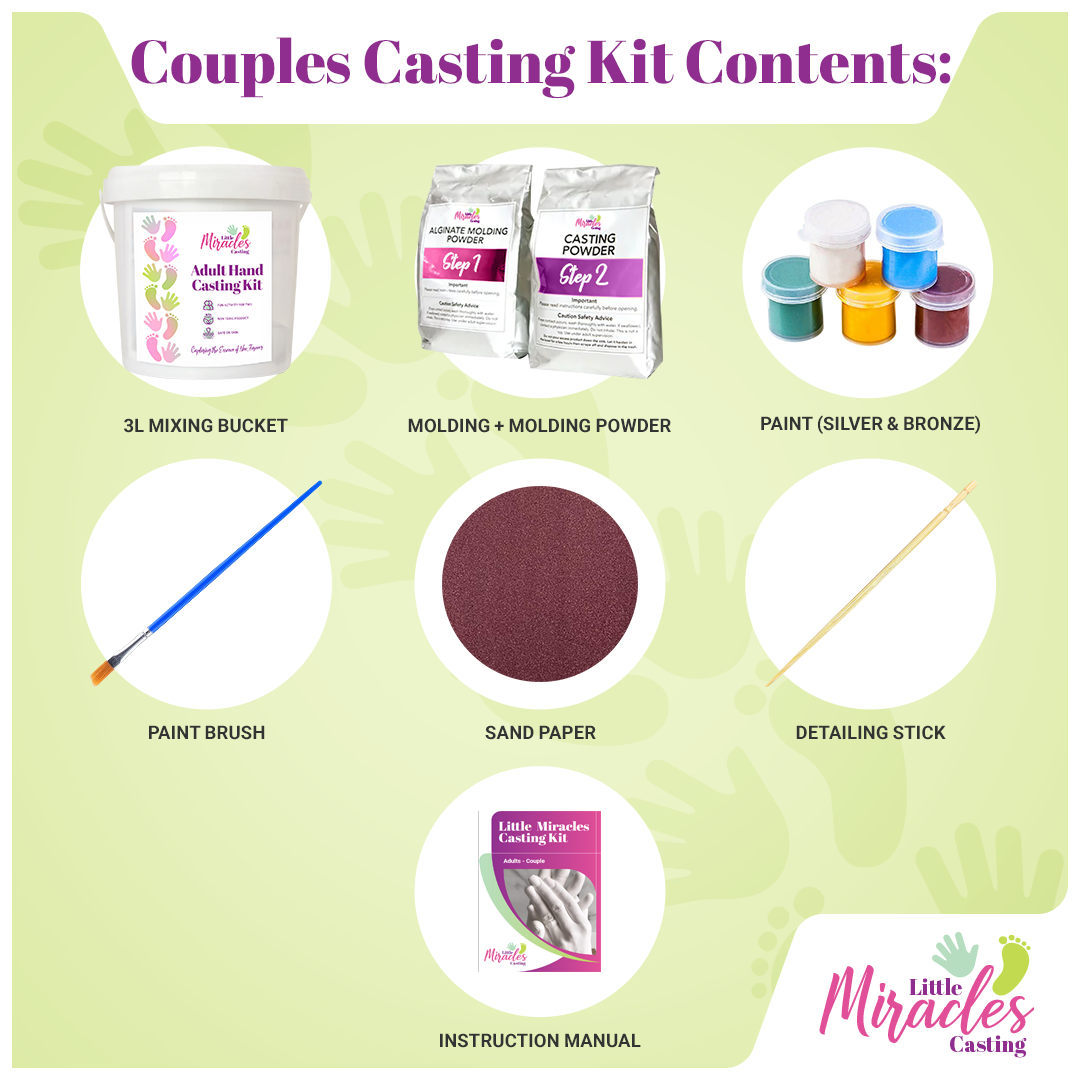
Couples Hand Casting Kit Contents:
1 x 3L Mixing Bucket
1 x Molding Powder
1 x Casting powder
1 x Detailing tool
2 x Paints - (gold & silver)
1 x Paint Brush
1 x Sandpaper
1 x Instruction Manual
*Suitable For:
- 2 x Adult Hands or,
- 1 x Adult Hand + 1 x Child Hand or,
- 1 x Large Adult Hand

Designed In Australia

Free shipping on orders over $100!

Non-Toxic & Safe On Skin

Kid & Pet Safe
Secure Online Payments
Support. Mon - Fri 9am -3pm AEST

CONTACT US
Get in touch with the team Send Us A Message
Download Kit Instructions
Shipping and Handling
Free Shipping on orders over $100
Tracking provided with all orders
Contact us for support
Frequently Asked Questions
How long do we need to hold hands in the casting material?
The casting process typically takes only a few minutes. You'll need to hold hands without moving until the casting material sets to ensure a clear, detailed mold. Full setting times vary, but expect to remain still for about 3-5 minutes.
How do I stop my casting mixture (alginate) from setting too quickly?
Alginate sets more quickly when the water or room temperature is warmer, so use cold water from the tap to give yourself as much time as possible to get it mixed. Using cold water will mean you need to keep still for longer. You should always use an electric mixer as getting our casting mixture mixed with a hand whisk or a wooden spoon is going to be incredibly difficult before it starts to set. Get a friend or family member to pour in the bags of alginate while you mix, this will mean you can just keep mixing and will save you time.
How do I avoid losing fingertips when casting our hands?
Hand position is very important! Make sure that fingertips of both hands are in contact with each other when you form the shape you’re going to dunk into the bucket. Fingertips that are ‘floating” are hard to fill with the stone. So, ensure it’s a nice loving hand grip. When pouring the plaster hold the mould at an angle. This way the fingertips of the cast are filled first. In case you do still lose some fingertips, we recommend holding back a bit of the casting powder (just a couple of spoonfuls) before mixing it up so you can make repairs. Mix equal parts of stone powder to water.
How do I avoid bubbles on the skin surface of my cast?
Make sure that the alginate is mixed as thoroughly and smoothly as possible. Another tip to avoid bubbles is to keep tapping the bucket during the stone pour. This releases air from the liquid stone. Keep tapping at every stage of the pour and after you’ve filled the mould up to the top of the wrists. Keep tapping both sides of the bucket until the liquid stone starts to thicken and then stop. This will bring all the bubbles to the surface and prevent the liquid stone from separating and forming channels or bubbles. But if you still encounter the above problem here’s how to fix it! You can carefully scrape away tiny bubbles using a suitable tool. Don’t try and flick them off as this will result in little craters on the skin surface. Our kits include a detailing tool that can be used for small bubbles or you can use a craft knife or scalpel. You should remove larger bubbles by gradually scraping them off. Do this carefully layer by layer until you reach the level of the skin surface. A craft knife or scalpel is best for this.